sábado, 2 de noviembre de 2013

Tries: Robshaw, Farrell - BBC Sport

England overcame both a dangerous Australia and their own shortcomings to grab a precious southern hemisphere scalp and get their autumn campaign off to a winning start.

Opportunistic second-half tries from skipper Chris Robshaw and fly-half Owen Farrell saw them overturn a seven-point deficit after Matt Toomua's try had seen them in trouble at the break.

Farrell kicked two penalties and added both conversions after earlier missing three kicks as the home side's superior scrum and forward power in the loose made up for a disjointed display elsewhere.

The win means England remain third in the International Rugby Board world rankings, with Australia - who could have displaced them with victory - staying in fourth.

More importantly, a decade on from England's sole World Cup win,  it gives Stuart Lancaster's side precious momentum as they look to build towards the 2015 tournament that they will host.

The new centre combination of Joel Tomkins and Billy Twelvetrees had helped give England an early lead when they scragged Tevita Kuridrani to set up a penalty for Farrell, Quade Cooper levelling it up after Dan Cole went offside in a brisk opening period.

Farrell would miss three more from similar range as his forwards made impressive inroads at the scrum and in the loose, but after a barrelling run from Billy Vunipola on his full debut the Saracens fly-half made it 6-3 just before the half-hour.

England were dominating possession and territory without ever looking fluent, their reshaped back line showing its inexperience and lack of familiarity.

And when Israel Folau beat Chris Ashton on the outside after a fine pass from Cooper, Australia recycled close in to send centre Toomua across the line through Twelvetrees' lacklustre tackle.

With Cooper adding both the conversion and a quick penalty, the Wallabies had 10 unanswered points to silence a previously bellicose Twickenham.

Only a poor miss from the tee from Cooper kept the deficit at seven points as England's struggles worsened after the break.

It took a brilliant side-stepping run from full-back Mike Brown from his own corner flag - replays subsequently showed he was actually just in touch when he first gathered the ball - to spark both his side and the capacity crowd into the life.

Only a desperate covering tackle from Adam Ashley-Cooper kept Marland Yarde out down the left after a quick tap penalty on halfway had been moved swiftly wide.

From the subsequent line-out Will Genia's clearing kick was charged down by Mako Vunipola, and Robshaw was quickest to the loose ball to gather and slide across the line.

Farrell's conversion levelled it up with half an hour left as Lancaster looked to add to the momentum by bringing on Ben Youngs, Dylan Hartley and Joe Marler.

It worked. Quick line-out ball was taken on by number eight Vunipola and then spread left to the dashing Brown, and although the Wallabies forwards slowed up the ball, Farrell spotted a gap between Stephen Moore and Ben Mowen to canter under the posts.

If there was a hint of obstruction from Hartley then television match official Marshall Kilgore was happy to let it pass, allowing Farrell to make it 20-13 with the conversion.

Cooper had the chance to seize back the impetus in this topsy-turvy affair with a penalty from distance only to pull it wide, but with the lead a mere converted try nerves tightened as the seconds ticked away.

Handling errors continued on both sides, but England's superior forward muscle allowed them to squeeze the remaining life from the Wallabies and secure their fifth consecutive win at Twickenham.

For the visitors it was a further chastening reverse in a year that has seen them win only three Tests.

But England will go into next week's match against Argentina confident of extending their run before the visit of the All Blacks in a fortnight provides a far sterner test of their World Cup credentials.

Team line-ups

England: Brown; Ashton, Tomkins, Twelvetrees, Yarde; Farrell, Dickson; M Vunipola, T Youngs, Cole, Launchbury, Lawes, Wood, Robshaw, B Vunipola.

Replacements: Morgan for Twelvetrees (66), B Youngs for Dickson (55), Marler for M. Vunipola (54), Hartley for T Youngs (54), Wilson for Cole (66), Flood for B Vunipola (66).

Not Used: Attwood, Foden.

Australia: Folau; Ashley-Cooper, Kuridrani, Toomua, Cummins; Cooper, Genia; Slipper, Moore, Alexander, Timani, Horwill, Fardy, Hooper, Mowen.

Replacements: McCalman for Ashley-Cooper (49), White for Genia (66), Robinson for Slipper (61), Faingaa for Moore (68), Kepu for Alexander (49), Douglas for Timani (62), Foley for Fardy (49).

Not Used: Lealiifano.

Att: 81,500

Ref: George Clancy (Ireland).

iPad Air STRIPPED NAKED, revealing she's a high maintenance lady - Register

Email delivery: Hate phishing emails? You'll love DMARC

Teardown According to the teardown fanatics at iFixit, Apple's new iPad Air is twice as easy to repair as Microsoft's equally new Surface 2 – which received an as-low-as-you-can-go repairability rating of 1 out of a possible 10.

Actually, it would be more accurate to say that the iPad Air is only one small step away from being as fiendishly difficult to repair as the Surface 2. The low, low repairability score of 2 that iFixit assigned to Apple's slimmed-down fondleslab after their teardown is certainly nothing to be proud of.

As iFixit wrote in an email, "The changes to the new iPad are bad for repairability, but not quite bad enough to halve its score from 2 to 1. It was an extremely close call, though. We wrestled with the decision for quite a long time before reaching our conclusion."

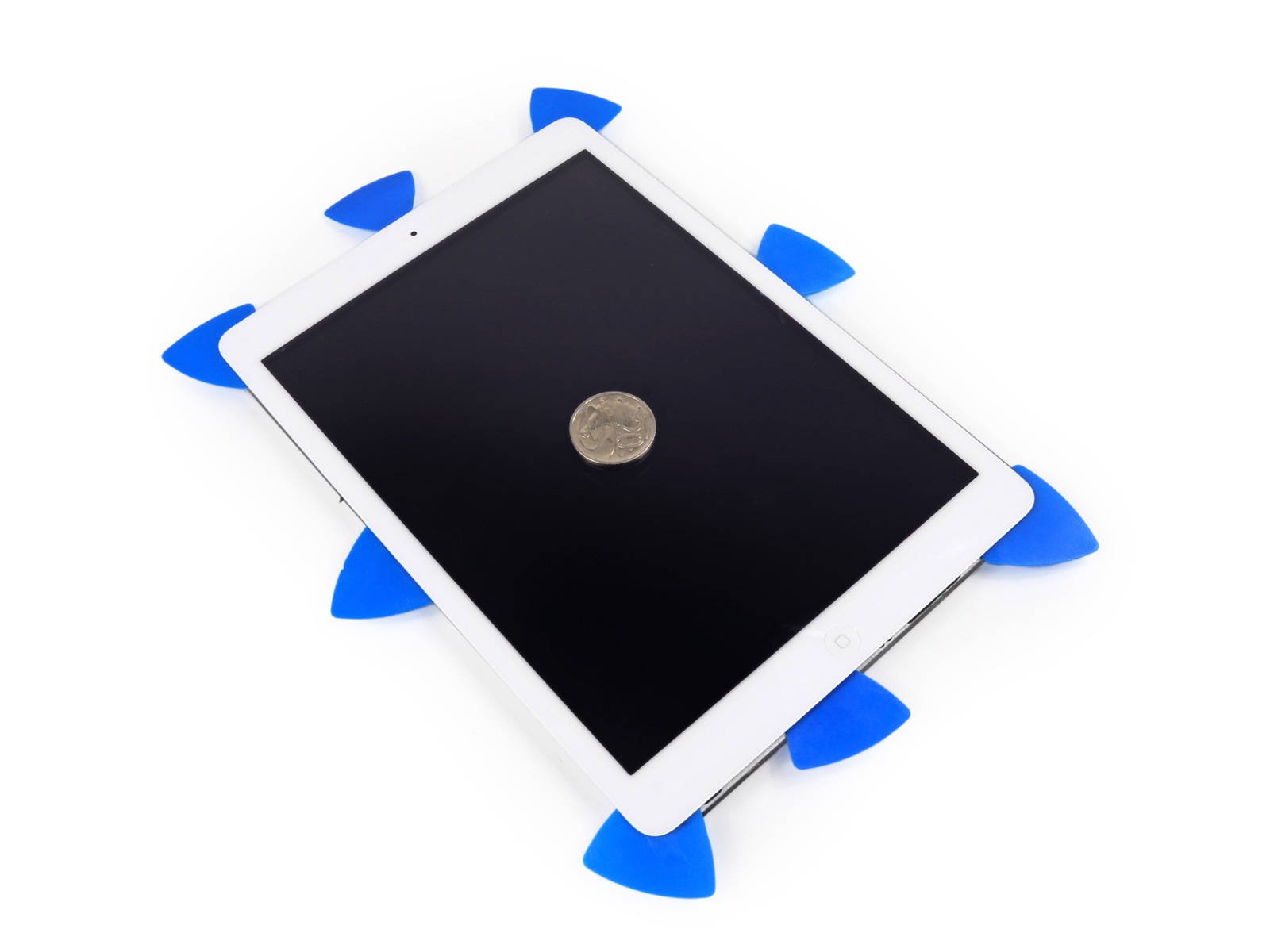
Copious amounts of adhesive was the villain in the teardown of the Surface 2, and that gunk makes its return in the iPad Air. Unlike the Surface 2, however, iFixit didn't have to break out their Chicago Heat Gun to loosen the gluey grip securing the iPad Air's case; their microwaveable iOpener heat pad was sufficient – along with the help of a handful of guitar picks.

iPad Air being opened with guitar picks

Oz readers will I.D. that coin as an Australian 20¢ piece – 28.5mm in diameter, by the way (click to enlarge)

After popping open the case and freeing the 2048-by-1536 pixel, 264 pixels-per-inch Retina display, the two-cell lithium-polymer battery was revealed. That battery, iFixit notes, provides 32.9WHr of juice, significantly less than its predecessor's 43WHr three-cell "behemoth." Apple's tech specs, by the way, report the capacity to be 32.4WHr.

Despite this large drop in capacity, however, Apple claims that the iPad Air's enhanced efficiency will still allow for "up to 10 hours of surfing the web on Wi-Fi, watching video, or listening to music."

iPad Air popped open

Why Apple understates the Air's battery capacity is an unknowable Cupertinian mystery (click to enlarge)

The amount of glue holding down the battery caused the iPad Air's Australian disassembler, iFixit reports, to send them "one, last, coherent message before strings of expletives" when attempting to remove the battery: "It's the worst battery ever," he said.

Fortunately, the iPad Air's logic board is not glued down, and removing it allowed iFixit and their pals at Chipworks to identify the chippery powering Apple's latest slab of shiny-shiny.

iPad Air logic board

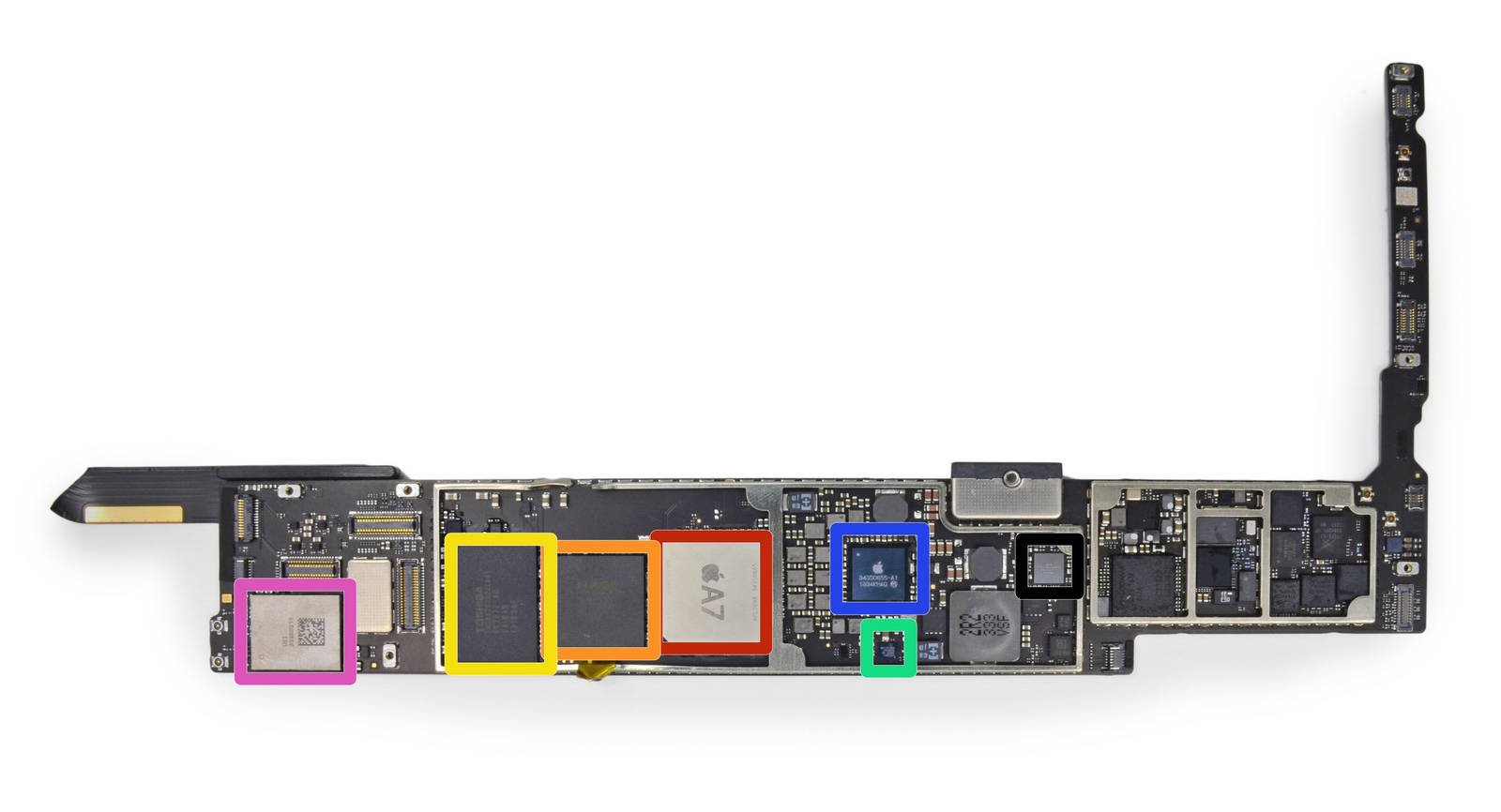
It turns out that an A7 is not an A7 is not an A7 (click to enlarge)

Interestingly, the A7 chip in the iPad Air, outlined in red and sitting next to 1GB of Elpida low-power DDR3 SDRAM outlined in orange, has a different ID number than does the A7 in the iPhone 5s – the Air's A7 is marked APL5698, while the A7 in the 5s is labeled APL0698.

Chipworks surmises that the renaming of the A7 is due to the fact that it's reported to run at 1.4GHz; the A7 in the iPhone 5s is said to run at 1.3GHz. "It's quite a hefty heat sink on the chip," they write, "so it's definitely running warmer." Alternatively, they say, the new designation could be due to a different pin-out needed to talk with the Elpida memory.

We'll ask Apple, and we're sure they'll tell us. That was a joke, by the way.

Other chips of interest include 16GB of Toshiba NAND Flash (yellow) and Apple's 338S1116 Cirrus Audio Codec (black), which iFixit says they also found in the iPhone 5c. For a full listing of all the chips, check out iFixit's teardown, which also includes 55 photos detailing the entire process.

And a painful process it was. The front panel is glued down, which increases the chances of cracking it when you attempt to remove it, for example, and the display is fastened to the front panel with foam sticky tape, which also boost the likelihood of inadvertent shattering upon removal.

All in all, the iPad Air is a bear to take apart for repair – but at least it's not a Microsoft Surface 2. ®

Free Regcast : Managing Multi-Vendor Devices with System Centre 2012

Cardiff hospital UHW apologises for miscarriage error - BBC News

Emily Wheatley said the hospital took away the joy of pregnancy

A Cardiff hospital has been forced to apologise for flaws in the way it diagnosed miscarriages over many years.

It follows the case of a woman wrongly told she had miscarried nine weeks into her pregnancy after a scan at the University Hospital of Wales.

Emily Wheatley, from Monmouth, went on to have a healthy baby daughter, Ella.

The Public Service Ombudsman for Wales believes flaws in UHW's practices may have gone back as far as 2006. A helpline has been set up for patients.

'Real shock'

Ms Wheatley was told during a dating scan she had suffered a silent miscarriage - where there are no symptoms.

She chose to undergo a uterine evacuation at Nevill Hall hospital in Abergavenny, but staff there discovered she was nine weeks pregnant with a healthy foetus.

Ms Wheatley suffers from polycystic ovary syndrome and endometriosis, meaning the chances of her conceiving naturally were "very, very slim".

"To be told that I'd miscarried was a real shock," she said.

"It took a lot to adjust to that after adjusting to the fact that I was pregnant in the first place."

After being told she was indeed still pregnant, she said: "Even though the baby was there clearly on the screen, I couldn't really believe it."

She said the hospital "took away the enjoyment of pregnancy".

'Unacceptable mistake'

She added: "It's just unbelievable actually that there are potentially other women out there who have been diagnosed with having a silent miscarriage... and they potentially have got rid of healthy babies. That frightens me."

"Maybe hundreds of babies have been lost because of their decision making, which is unthinkable."

Peter Tyndall, Public Service Ombudsman for Wales, said it was an "unacceptable mistake" which should have been avoided and he has called a review of midwife sonographers' competency.

He said staff, after discovering a silent miscarriage, should have used a different scan to give them a "more accurate picture", but failed to do so.

In a report, he says the health board "failed to implement guidelines issued by the Royal College of Obstetricians and Gynaecologists (RCOG) that were designed to prevent the misdiagnosis of early pregnancy loss" and had been using out-dated guidance for two years or more.

Emily Wheatley, from Monmouth, was wrongly told she had miscarried

Asked how many other people could have been affected, he replied: "You'll have to ask the health board but clearly there will have been others.

"The health board has set up a helpline for other women who think they may have been affected.

"We'd advise them if they are concerned to contact the helpline."

Mr Tyndall said he thinks Ms Wheatley's case is "unusual and I don't think it's typical", but he said other women may have been similarly affected.

The ombudsman made a series of recommendations, including that the health board issues a written apology and pays the woman £1,500.

The helpline - 0800 952 0244 - was launched on Friday and will remain open from 09:00 to 17:00 daily until 17:00 GMT on 4 November.

'Genuinely sorry'

Dr George Findlay, Cardiff and Vale Health Board director for children and women's services, said about 6,000 deliveries are performed each year, and between 600 and 1,200 people have a miscarriage.

"Start Quote

We let her down and we didn't provide a standard of care that's acceptable to me as a doctor or me as a manager"

End Quote Dr George Findlay Cardiff and Vale Health Board

"We're saying that about 600 women per year may have a miscarriage that leads to an intervention by us," he said.

"What I don't know right now is what type of scan or number of scans that these patients had and we're happy to look at that on a case by case basis."

Dr Findlay added: "We let her down and we didn't provide a standard of care that's acceptable to me as a doctor or me as a manager."

Cardiff and Vale University Health Board's executive director of nursing, Ruth Walker, offered an "unreserved" apology to Ms Wheatley and said the said the board was "genuinely sorry that it has taken an ombudsman's report for her to receive the answers she deserved".

She said that correct procedures were now followed.

She added the helpline had received 28 calls throughout the day on Friday.

"We were able to immediately reassure eight of those patients regarding their care and will be speaking further with 10 other patients in the coming days.

"There were also 10 calls from patients outside the Cardiff and Vale area which we were able to redirect accordingly."

Is this the end to sky-high energy bills? Thermoelectric wristband which will keep ... - Daily Mail

  • Revolutionary design aims to heat the person not the building
  • Wristify works by monitoring temperature before sending warm or cold pulses to the skin to heat or cool the entire body
  • Four engineering students at Massachusetts Institute of Technology behind the competition-winning invention

By Lizzie Parry

|


With energy bills soaring and no sign of prices coming down one team of scientists in America may have come up with the answer - heat the person not the building.

Inspired by a desire to reduce energy consumption a team of four engineering students at the Massachusetts Institute of Technology (MIT) flipped the age-hold worry of heating your home on its head.

Focusing on the innovative idea of cooling and heating people rather than entire buildings, the team developed a thermoelectric bracelet.

Innovative: A team of scientists at MIT have developed a new wrist watch to help regulate body temperate. The aim is to solve the problem of soaring energy bills, heating the person rather than the building

Innovative: A team of scientists at MIT have developed a new wrist watch to help regulate body temperate. The aim is to solve the problem of soaring energy bills, heating the person rather than the building

The idea was borne out of the concept that heating or cooling parts of your body can help influence how hot or cold we feel in general.

A cool flannel placed on your head can sooth a fiery temperature while a pair of handwarmers can help skiers and hikers warm up.

The invention, dubbed Wristify, takes advantage of this, working by monitoring air and skin temperature, and sends tailored pulses of hot or cold waveforms to the wrist to help maintain a comfortable temperature.

HOW WRISTIFY WORKS

The wrist watch can be can be powered for up to eight hours by a lithium polymer battery. 

The 'watch' part of the prototype consists of the team's custom copper-alloy-based heat sink - a component that lowers a device's temperature by dissipating heat.

Attached is an automated control system that manages the intensity and duration of the thermal pulses, delivered to the heat sink.

Integrated thermometers also measure external and body temperature to adjust accordingly.

'Buildings right now use an incredible amount of energy just in space heating and cooling, said Sam Shames, a materials science and engineering student who co-invented the Wristify technology.

'In fact, all together this makes up 16.5 percent of all US primary energy consumption.

'We wanted to reduce that number, while maintaining individual thermal comfort.

'We found the best way to do it was local heating and cooling of parts of the body.'

The team has estimated that if the device stops one building from varying in temperature by one degree Celsius, it will save around 100 kilowatt-hours per month.

It comes as four of the big six energy suppliers in the UK have already hiked their bills this year.

ScottishPower bills are going up by 9 per cent, npower announced a 10.4 per cent price hike, British Gas a 9.2 per cent rise and Scottish & Southern Energy an 8.2 per cent increase.

It means the average cost of keeping our homes warm has reached around 610 annually - up from 360 in 2008, the Independent revealed.

Wristify: The device works by monitoring body temperature and then regulating it by delivering warm or cool pulses to the skin

Wristify: The device works by monitoring body temperature and then regulating it by delivering warm or cool pulses to the skin

The Wristify team took home the first prize at this year's MADMEC, MIT's annual materials-science design competition, receiving funding to create a working prototype.

The annual competition, now in its seventh year, is run by MIT's Department of Materials Science and Engineering (DMSE), and is sponsored by Saint Gobain, BP, and Dow Chemical.

The contest's theme this year was 'materials science solutions for sustainability'.

Michael Tarkanian, a lecturer in DMSE who runs MADMEC said while some teams may further develop their products, taking them to market, the primary aim is to get students involved in the design and prototype process.

First prize: The team behind Wristify won first place in the MIT's annual MADMEC competition, receiving funding to develop their prototype

First prize: The team behind Wristify won first place in the MIT's annual MADMEC competition, receiving funding to develop their prototype

He said: 'The goal is to allow students to get their hands dirty, working in the labs to design and build functional prototypes.

'It gives them an opportunity to put their classroom knowledge to work, solving problems related to energy, habitat, and sustainability.'

In developing their 15 prototypes, before landing the final product, the team discovered human skin is very sensitive to minute, rapid changes in temperature, which affect the whole body.

They discovered they needed to heat or cool any body part - in this case a wrist - at a rate of at least 0.1C per second in order to make the entire body feel several degrees warmer or cooler.

The final product resembles a wrist watch and can be powered for up to eight hours by a lithium polymer battery. 

The 'watch' part of the prototype consists of the team's custom copper-alloy-based heat sink - a component that lowers a device's temperature by dissipating heat.

Attached is an automated control system that manages the intensity and duration of the thermal pulses delivered to the heat sink.

Integrated thermometers also measure external and body temperature to adjust accordingly.

'What we developed is a wearable, wrist-based technology that leverages human sensitivity, can detect and perfect rates of change, and can maintain overall thermal comfort while reducing the need to heat and cool buildings,' added Mr Shames.

With their prize money, the team, also made up of graduates Mike Gibson and David Cohen-Tanugi and post doctorate student Matt Smith, plans to further develop the prototype.

The comments below have not been moderated.

This isn't new to motorcyclists, who already wear battery heated underwear but there's no fun in breathing in mould spores from an unheated atmosphere.

Im sure the phama companies will want some sort of cancer inducing chemical incorporated into the system to keep their end of the bargain.

Or you can inject people with drugs that stop them from feeling cold because they desensitise or nerve endings! So when you die of hypothermia, you won't feel a thing! Quick, issue these armbands to every pensioner in the country!

Isn't this a sort of electric blanket then?

When open fires were around you used to lift your coat and warm your RR's, funny how your front was still freezing? I can't see anything in a particular area heating your WHOLE body? That will require SURROUNDING heat.

There is enough energy falls on the average house to keep it warm and supplied with electricity every year. Its just getting the equipment in place to capture all this free energy. No gas bills, no electricty bills, no pylons, no one trying to make you switch.

Hopefully this will evolve into a much larger wall-mounted design for each room.

I want one please!

No ! Greed comes first in the great UK ideas like this wont generate enough profit for the utilities so expect to be hit elsewhere in the pocket !

i want one now as im cold all the time

The views expressed in the contents above are those of our users and do not necessarily reflect the views of MailOnline.

Pair Charged With Murder Over Bodies In Garden - Sky News

The daughter and son-in-law of an elderly couple who went missing from Mansfield have been charged with murder, say police.

Susan Patricia Edwards, 55, and Christopher John Edwards, 57, have each been charged with two counts of murder, according to Nottingham Police.

The pair, of no fixed address but who are believed to have been living outside the UK, will remain in police custody until their appearance before Nottingham magistrates tomorrow.

The remains of a man and woman were found buried in the back garden of a house in Blenheim Close, Forest Town, on Wednesday 9 October 2013.

Police have not yet formally identified the pair, but believe they are William and Patricia Wycherley, who lived at the house in the 1990s.

A police spokesman said: "A Home Office pathologist has determined that both people died as a result of being shot."

The elderly couple moved to the address in 1987 and according to neighbours, disappeared in 1998.

Officers have said Mrs Wycherley is believed to have been born in Fulham, west London, and would now have been 79. Her husband would have been 100.

Police said bone analysis has shed further light on the remains.

More follows...

Bale, Ronaldo star in Real Madrid's 7-3 win over Sevilla - Al-Bawaba

The combined efforts of new Real Madrid signing Gareth Bale and star Cristiano Ronaldo sent their side to a 7-3 victory over Sevilla in the La Liga on Wednesday.

Bale, who replaced Ronaldo as the world's most expensive player following his 85 million-pound signing from Tottenham Hotspur, hit the first two goals of the night in the opening half-hour, which were also his debut goals for the club.

According to the Mirror, not to be left behind, Ronaldo took the kick after Madrid was awarded a 32nd-minute penalty to open his account for the night, which he celebrated with a military salute.

Ronaldo then completed his hat-trick with further goals in the 60th and 71st minute, both efforts coming in between a second-half brace from Karim Benzema .

Sevilla also impressed as an attacking force in an incident-packed game as well, and they recovered from 3-0 down to 3-2 at half-time thanks to goals from Ivan Rakitic (penalty) and Carlos Bacca just before the break, the report added. (ANI)

David Beckham's son reportedly given tryout with dad's former club - CBSSports.com

David Beckham's son, Brooklyn, has reportedly trained with Manchester United.
David Beckham's son, Brooklyn, has reportedly trained with Manchester United. (Getty Images)

Brooklyn Decker, the 14-year-old son of soccer legend David Beckham, reportedly trained with Manchester United Thursday in hopes of receiving an offer to play for the club in which his father once starred.

Several outlets have reported that the training has taken place, and that future trials are in the works. Brooklyn has also trained with Chelsea and has been involved in the Queens Park Rangers Academy since the beginning of the year.

So does this mean the younger Beckham will one day be suiting up for dad's former squad?According to the Daily Mail, probably not. The paper reports Brooklyn will not be offered a deal.

David, meanwhile, has been busy, too. Earlier this week, it was announced that he would bring an MLS franchise to Miami.